This post may contain affiliate links. Please read my disclosure for more information.
Let’s face it. Money just disappears! Sometimes to me it can feel like as soon as my paycheck is in my account, it is well on its way out of my account.
Understanding where your money is going, and finding ways to spend it better can help you find financial freedom.
Creating a budget is a simple and best first step to improving your money management. And best of all, it is really simple and easy to do.
To budget money, start with your take-home pay, list your fixed and variable expenses, pick a system like the 50/30/20 breakdown, and check your progress every month.
That’s it. You don’t need a finance degree or fancy software to make it work.
The payoff is real. A budget lowers financial stress, gives you a clear picture of your cash flow, and helps you take control of your money instead of guessing.
Below, you’ll find the steps, a few popular methods, and tips for matching your income and expenses to the financial goals that matter most to you.
Start With Your Actual Take-Home Income
Every budget starts with one number: the money that actually lands in your bank account.
That figure is your take-home pay, and it’s usually a good deal smaller than the salary listed on your job offer.
Budgeting Methods:
Calculate Net Income From Paychecks
Look at your most recent pay stub and find the bottom line. That deposit amount is your after-tax income, also called net income or take-home pay.
Taxes aren’t the only thing pulled out. Your employer may also deduct:
- Health, dental, and vision insurance premiums
- 401(k) or other retirement contributions
- HSA or FSA contributions
- Union dues or parking fees
Here’s a detail people miss. If money comes out for your 401(k) or insurance, add those amounts back in when you build your budget so you can see your full income and where it’s already going.
To find your monthly income, multiply weekly pay by 52 and divide by 12. For biweekly pay, multiply by 26 and divide by 12.
Plan Conservatively for Irregular Income
If you freelance, work on commission, or pick up shifts that change week to week, you have irregular income. Averaging your last 12 months won’t help much during a slow stretch.
Instead, use your lowest-earning month from the past year as your baseline budget. Cover rent, groceries, utilities, and minimum debt payments with that number.
When a strong month arrives, the extra doesn’t disappear into spending. Send it to your emergency fund, next month’s bills, or debt.
Don’t forget self-employment taxes. Set aside roughly 25% to 30% of each payment for federal and state taxes, plus subtract business costs like software, mileage, or supplies before you call any of it spendable.
More reading:
Separate Gross Income From Spendable Money
Gross income is your pay before anything is removed. It matters for loan applications and tax brackets, but it’s a poor budgeting tool.
Say you earn $60,000 a year. That’s $5,000 a month gross. After federal and state taxes, Social Security, Medicare, and a health plan, you might deposit closer to $3,800.
Budgeting off the $5,000 leaves you $1,200 short every month.
| Term | What It Means | Use It For |
|---|---|---|
| Gross income | Pay before deductions | Loan apps, tax planning |
| Net income | What hits your account | Building your budget |
| Disposable income | Net income minus needs | Wants, savings, extra debt payments |
Build your plan on the middle row. Your income minus your expenses is what you have left to assign a purpose.
Track Expenses and Build Useful Spending Categories
Your budget only works if you know where your money actually goes.
Sorting your spending into clear categories shows you which bills stay the same, which ones bounce around each month, and which ones sneak up once or twice a year.
You can even use budgeting apps to help you do this digitally. If you want to know how to budget for beginners, using an app can help guide you.
List Fixed Monthly Commitments
Start with the bills that stay the same, or close to it, every month. These are your fixed expenses, and they usually take the biggest bite out of your paycheck.
Write down each one with its due date and amount:
- Housing: rent or mortgage, property taxes, HOA fees
- Insurance: health, auto, renters or homeowners
- Debt payments: car payments, student loans, personal loan payments, minimum credit card payments
- Child care: daycare, after-school programs
- Subscriptions: phone plan, internet, streaming services
Some utilities land here too, though your electric or gas bill may shift with the seasons.
Housing and utilities often make up the largest chunk of a budget, so seeing that number in writing tells you how much room you have left.
Identify Variable Spending Patterns
Variable expenses change from week to week, and that’s where most people lose track. Groceries, dining out, gas, rideshares, shopping, entertainment, and household items all belong here.
Pull up two or three months of bank and credit card statements. Group similar purchases together and add up each group.
You’ll probably spot something surprising, like $340 on food delivery or $85 in coffee runs.
Keep groceries and restaurants in separate spending categories. They feel like the same thing, but one is a need and the other is mostly flexible.
Most people do fine with 8 to 15 budget categories. Too few and you miss patterns. Too many and tracking becomes a chore you skip.
Pick a method you’ll actually stick with, whether that’s a spreadsheet, an app, or a paper notebook.
Account for Annual and Irregular Costs
These are the expenses that wreck an otherwise solid budget. They don’t show up monthly, so they’re easy to forget until the bill arrives.
Common ones include:
| Expense | Typical Timing |
|---|---|
| Car registration and maintenance | Yearly or as needed |
| Insurance premiums paid in full | Every 6 or 12 months |
| Holiday and birthday gifts | Seasonal |
| Travel and vacations | Once or twice a year |
| Medical deductibles and copays | Unpredictable |
| Home or appliance repairs | Unpredictable |
Add up what you spent on these last year, then divide by 12. If gifts cost you $1,200, set aside $100 a month in a sinking fund category so December doesn’t hit your credit card.
Keep that money in a separate savings account. Mixing it with your checking balance makes it too easy to spend.
Set Priorities Before Assigning Your Money

Every dollar you earn has a job, but not every job matters equally.
Rent, groceries, and your minimum debt payments come first, then savings goals, then the fun stuff — and knowing that order makes each spending decision easier.
Cover Needs Before Wants
Needs and wants are building block budgeting categories to use.
Needs are expenses that keep you housed, fed, healthy, and able to work. Wants are everything else.
Start by listing your necessities: housing, utilities, groceries, transportation, insurance, child care, and the minimum payments on any loans or credit cards.
Many budgets, including the 50/30/20 method, aim to keep these at about half of your take-home pay.
If your needs eat up more than half your income, that isn’t a failure. It just means you may need a different split, like 60/20/20.
The line between a need and a want isn’t always clear. Is food delivery a need on a busy week? Is a gym membership part of your health care? Decide what counts for you, and be honest about it.
Include Savings and Debt in the Plan
Savings shouldn’t be whatever happens to be left over at the end of the month. Treat it as a bill you owe yourself.
The “pay yourself first” approach means you move money into a savings account or retirement account the day you get paid, before you spend on anything optional. Automating that transfer removes the temptation to skip it.
Here’s a workable order for that money:
| Priority | Why it comes first |
|---|---|
| Starter emergency fund | Covers small repairs so you don’t reach for a credit card |
| Employer 401(k) match | Free money you lose if you skip it |
| High-interest debt | Credit cards and payday loans cost the most in interest |
| Retirement savings | Experts often suggest 10–15% of pre-tax income |
| Extra debt payoff | Lower-rate loans like student debt or a mortgage |
Long-term savings and debt repayment can share the same slice of your budget. What matters is that both get a set amount each month, not just leftovers.
Prepare for Expected and Unexpected Costs
Two kinds of costs wreck budgets: the ones you forgot about and the ones nobody could predict.
For unexpected expenses — a broken water heater, an urgent vet visit — build an emergency fund.
Starting at $500 is reasonable if three to six months of living expenses feels out of reach right now.
For expected but irregular costs, use sinking funds. You divide a known future bill by the number of months until it’s due, then save that amount each month.
Common sinking funds include:
- Car maintenance — tires, oil changes, registration
- Holiday gifts — spread over 10 or 12 months
- Annual insurance premiums — paid once or twice a year
- Home repairs — roof, appliances, plumbing
Keep these separate from your emergency fund so you always know what each pile of money is for.
Choose a Budgeting Method That Fits Your Life
The best budgeting system is the one you can keep using month after month.
Three popular budgeting methods cover most needs: a simple percentage split, a detailed plan where you assign every dollar, and a hands-on approach that puts hard spending limits on the categories you tend to overspend.
Use the 50/30/20 Framework for Simplicity
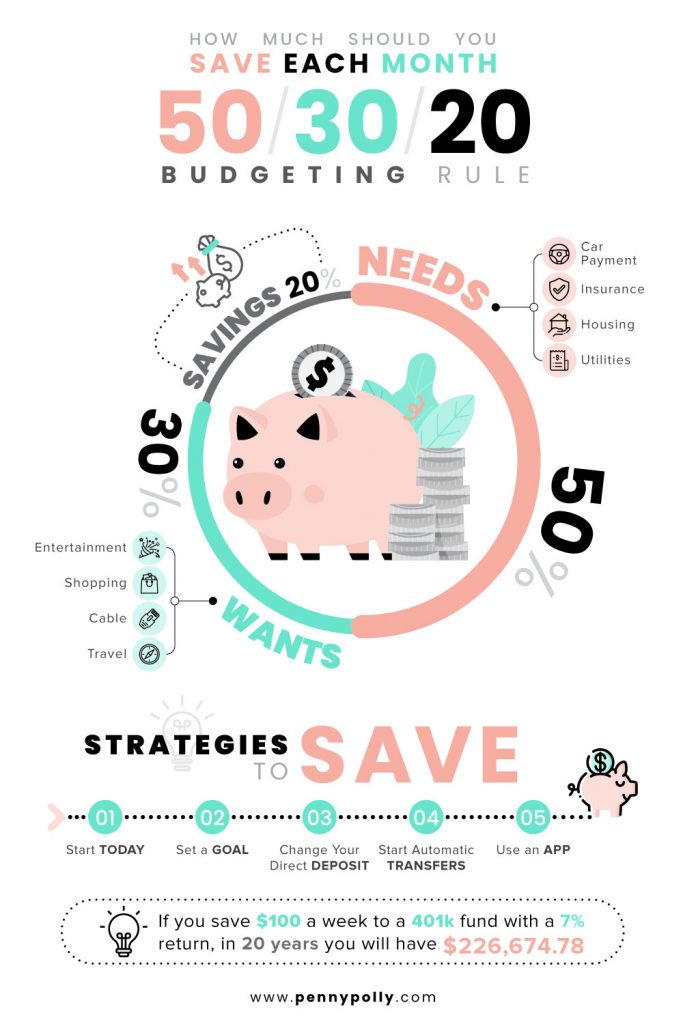
The 50/30/20 budget rule splits your take-home pay into three buckets:
| Bucket | Share | What goes here |
|---|---|---|
| Needs | 50% | Rent, groceries, utilities, insurance, minimum debt payments |
| Wants | 30% | Dining out, streaming, travel, hobbies |
| Savings and debt payoff | 20% | Emergency fund, retirement, extra loan payments |
If your monthly take-home pay is $4,000, that works out to $2,000 for needs, $1,200 for wants, and $800 for savings and debt.
This method works well if you hate tracking every purchase. You only check three numbers instead of twenty.
The percentages are a starting point, not a rule you must follow exactly. High rent may push your needs past 50%, so you trim the wants bucket to stay balanced.
Many guides list the 50/30/20 rule as the best fit for beginners because it takes very little setup.
Assign Every Dollar With a Zero-Based Plan
In a zero-based budget, your income minus your planned spending equals zero.
That does not mean your bank account hits zero. It means you give every dollar a job before the month starts, including dollars headed to savings.
Say you bring home $3,500. You might assign $1,200 to rent, $450 to groceries, $300 to gas, $200 to utilities, $150 to insurance, $400 to fun, $500 to savings, and $300 to extra debt payments. Add it up and nothing is left unassigned.
Zero-based budgeting takes more effort. You plan each month fresh and adjust as bills change.
The payoff is control. Because you decide where money goes ahead of time, zero-based budgets suit people who want maximum control over their cash.
It also handles irregular expenses well, like a car registration fee you know is coming in March.
Control Flexible Spending With Envelopes
The envelope method sets a fixed amount for the categories where you tend to overspend, then stops you when that amount runs out.
With the traditional cash envelope system, you withdraw cash and split it into labeled envelopes: groceries, gas, eating out, personal spending.
When the eating-out envelope is empty, you cook at home until next month.
You do not have to use paper envelopes. Many banking apps and budgeting tools let you create digital envelopes or separate sub-accounts that do the same job.
Envelope budgeting works best on variable costs. Fixed bills like rent and insurance still get paid from your checking account.
The main benefit is that spending limits become physical and obvious. Handing over cash makes the limit feel real in a way that swiping a card does not, which is why the envelope method helps curb impulse spending.
Create Your First Monthly Spending Plan
Your first monthly budget is just a simple plan that assigns every dollar of take-home pay to a job.
Once you know your income and expenses, you can pick a tool to organize the numbers and set aside money for the things you enjoy.
Match Planned Expenses to Available Income
Start with your take-home pay, not your salary before taxes. If you get paid every two weeks, multiply one paycheck by 26 and divide by 12 to find your monthly income.
Next, list your budget categories and give each one a dollar amount. Fixed expenses like rent, car payments, and insurance come first because the amount barely changes.
Then add variable expenses such as groceries, gas, and streaming services. Subtract everything from your income.
If the total is above your income, cut back on wants before touching needs. If money is left over, send it to savings or debt so expenses subtracted from income equals zero.
Use a Template, Worksheet, or Budget Planner
You do not need fancy software. A budget template, printed worksheet, or notebook all work as long as you actually use it.
Here are three common options:
| Tool | Best for | Effort |
|---|---|---|
| Paper worksheet | People who like writing things down | Highest |
| Spreadsheet | Custom categories and quick math | Medium |
| Budgeting app | Automatic tracking of income and expenses | Lowest |
Apps can connect to your bank and sort purchases for you. A spreadsheet gives you more control over budget categories.
The Consumer Financial Protection Bureau offers a free spending tracker, and many sites publish monthly budget examples and templates you can copy.
Pick one and stick with it for at least three months.
Make Room for Flexible and Fun Spending
A budget with zero fun money rarely lasts. Plan for entertainment, dining out, and hobbies on purpose instead of pretending you will skip them.
The 50/30/20 method is one easy guide: 50% for needs, 30% for wants, and 20% for savings and debt payments.
If those percentages do not fit your situation, adjust them. Someone with high rent may only have 15% left for wants.
Try giving yourself a set amount each month for flexible spending. When that money runs out, you wait until next month.
Also build in a small buffer for surprise costs like a car repair or a gift. That padding keeps one bad week from wrecking the whole plan.
Keep the Budget Working Month After Month
A budget only helps if you check it often and change it when your life changes.
Short weekly reviews, automatic transfers, and a few smart swaps at the store will keep your plan running without much effort.
Review Spending Weekly and Adjust Categories
Set aside 10 to 15 minutes each week to look at your transactions. Pick the same time, like Sunday morning, so it becomes a habit.
Compare what you spent to what you planned in each category. If groceries are at $420 with two weeks left in a $500 budget, you know to slow down or move money from another category.
A budgeting app makes this faster. YNAB, Monarch Money, and Simplifi by Quicken all pull in transactions and sort them for you.
Don’t treat overspending as failure. If your rent or insurance goes up, change the numbers.
NerdWallet suggests you check your budget every few months and switch systems if the one you picked isn’t fitting your life.
Automate Savings and Bill Payments
Automatic transfers remove the choice from the equation. Set up a transfer to your savings account on payday, so the money leaves before you can spend it.
Start small if you need to. Even $25 per paycheck builds a habit, and you can raise the amount when a raise comes in.
Do the same with bills:
- Fixed bills (rent, car payment, insurance) — set up autopay for the full amount
- Credit cards — autopay at least the minimum, then pay more by hand
- Retirement — payroll deduction into a 401(k), especially up to your employer match
If your income changes month to month, autopay for savings can cause overdrafts. Instead, set a calendar reminder to move money after each paycheck lands.
Some people find a friend or online group helpful for staying accountable when income is uneven.
Find Sustainable Ways to Reduce Spending
Big cuts you hate won’t last. Look for changes you barely notice.
Generic brands are one of the easiest. Store-brand groceries and household items — pasta, cleaning spray, pain relievers, paper towels — often cost 20% to 30% less than name brands with similar ingredients.
Then check your fixed costs once a year:
| What to Review | What to Try |
|---|---|
| Cell phone plan | Move to a cheaper carrier or lower data tier |
| Car insurance | Get three quotes and ask about bundling |
| Subscriptions | Cancel anything you haven’t used in 60 days |
| Streaming services | Rotate one at a time instead of keeping all |
Cutting a fixed bill saves you money every month without any ongoing effort. That’s different from telling yourself to stop buying coffee, which takes daily willpower.
If you’re living paycheck to paycheck, put the savings toward a starter emergency fund first.
Even $500 keeps a car repair from turning into credit card debt, and practical strategies like spending resets can help you free up that first chunk of cash.
Frequently Asked Questions & BUdgeting Tips
Budgeting questions usually come down to a few practical things: picking a method, finding free tools, saving money on a tight paycheck, and planning past the next 30 days.
The answers below cover monthly setups, student-friendly options, and how to map out a full year.
What is the best way to create a monthly budget?
Start with your take-home pay, not your salary before taxes. That’s the real number you have to work with.
Next, list your fixed bills: rent or mortgage, car payment, insurance, phone, and any subscriptions. These stay about the same every month, so they’re easy to plan around.
Then add your variable costs like groceries, gas, and eating out. Look at two or three months of bank statements to get honest averages instead of guesses.
Whatever is left over gets a job. At its simplest, a budget is your income minus expenses, with the remainder assigned to savings, debt payoff, or spending you don’t feel bad about.
Don’t forget bills that show up once or twice a year. Setting aside money each month for holidays, birthdays, and dentist visits keeps them from wrecking a single month’s plan.
How can beginners start budgeting for free?
A notebook and a calculator work fine. So does a blank spreadsheet in Google Sheets or Excel, and free budget templates are built into both.
Several apps offer free versions, including Goodbudget and PocketGuard, with paid tiers that add features. Apps that charge a fee often include a free trial, which you can use to learn the system before deciding.
Your bank may already have spending categories built into its app. Check there before signing up for anything new.
How do I budget on a low income?
Cover the essentials first. Housing and utilities come first, then food, then medicine and transportation.
Everything else is a choice you make with what’s left. That includes restaurants, streaming services, and clothes beyond what you need.
Percentage rules like 50/30/20 often don’t fit smaller paychecks, since needs alone can eat up 70% or more. Use the categories as a rough guide, not a rule you have to hit.
Even $10 or $20 a month into savings builds a habit and a small cushion.
If the numbers still don’t work after cutting costs, the problem may be income rather than spending, and picking up extra hours or side work may be the fix.
How much money should I save each month?
A common target is 20% of your take-home pay split between emergency savings, retirement, and other goals. Start lower if that feels out of reach.
Build an emergency fund first. Three to six months of expenses is the standard advice, but $500 to $1,000 is a reasonable first milestone.
If your job offers a 401(k) match, contribute at least enough to get the full match. That’s an immediate return you won’t find elsewhere.
For retirement math, one rough guideline multiplies your desired yearly retirement income by 25. Want $60,000 a year? That points to roughly $1.5 million saved.
What budgeting method is best for students?
Zero-based budgeting tends to work well when money is tight and income is irregular. You assign every dollar a category until you reach zero, which forces you to notice small purchases.
The envelope method is another good fit. Put a set amount of cash in labeled envelopes for food, gas, and fun, and when an envelope is empty, that category is done for the week.
Budget by term or semester if your income comes in chunks from financial aid or summer work. Divide the total by the number of months it needs to cover.
Track textbooks, lab fees, and course materials as their own line item. These hit hard at the start of each semester and are easy to forget when planning.
How can I make a yearly budget plan?
Take your monthly budget and multiply by 12 as a starting point. Then adjust for the months that don’t look average.
Mark the expenses that only happen once or twice a year:
- Car registration and insurance premiums
- Property taxes
- Annual subscriptions and memberships
- Holiday gifts and travel
- Back-to-school or semester costs
Divide each of those totals by 12 and save that amount monthly. A $1,200 insurance premium becomes $100 set aside each month.
Include raises, bonuses, or tax refunds you reasonably expect. Decide ahead of time where that money goes so it doesn’t disappear.
Review the plan every three months. Rent goes up, jobs change, and a budget you check regularly stays useful instead of turning into a document you ignore.
Start Budget Planning Today
It isn’t as hard as you think to start a budget! Just get started.